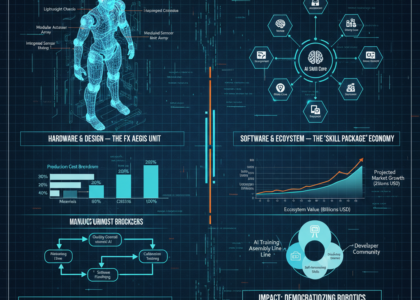



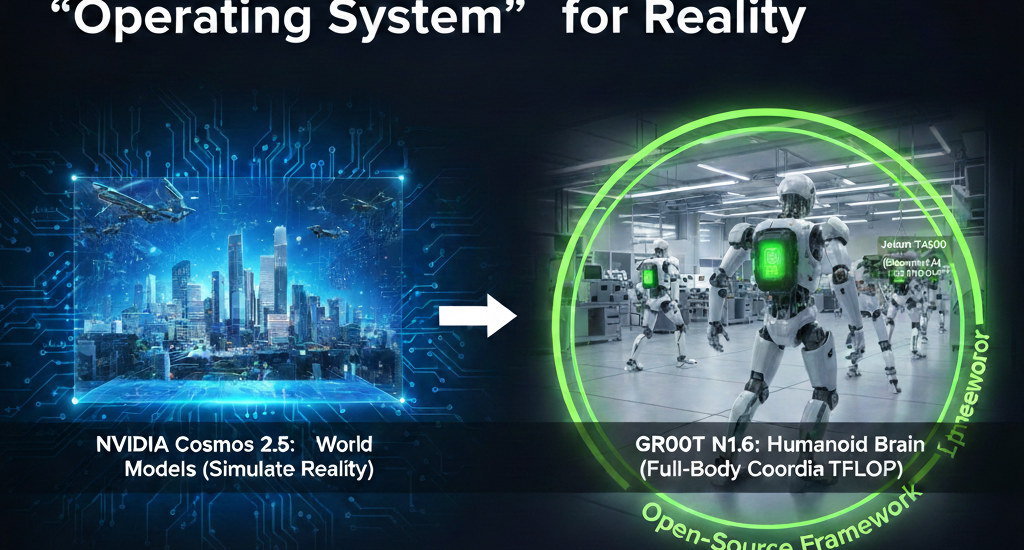
The biggest hurdle in robotics has always been data. You can’t crash a $100k humanoid a million times to teach it to walk—but you can in Cosmos 2.5. This post dives into Cosmos Predict and Transfer, the world foundation models that allow robots to ‘dream’ 30-second, physics-accurate simulations. Discover how ‘Sim-to-Real’ pipelines are now 60% more accurate, allowing robots to master edge cases in virtual worlds before they ever step onto a factory floor.
Advanced AI used to require a server rack; in 2026, it fits in a 70-watt module. We break down the specs of the NVIDIA Jetson T4000. Built on the Blackwell architecture, this module delivers 4x the AI compute of the previous generation. From autonomous transport grids to surgical robots, learn why this $1,999 powerhouse is the new standard for ‘Brains-on-Board’ and how it handles the massive reasoning requirements of the GR00T foundation model
Would you like me to generate a technical comparison table for the Jetson T4000 vs. Jetson Orin to include as a “Cheat Sheet” for your developer audience?
– Usama Aslam
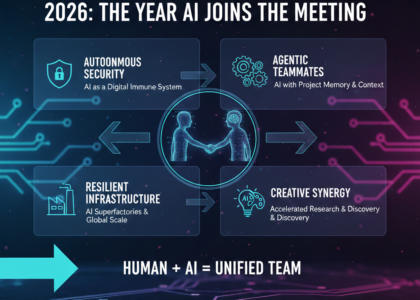
Automation is predictable; reality is not. Cosmos Reason 2 is the reasoning engine that helps robots navigate the ‘long tail’ of unexpected events. Whether it’s a social robot identifying subtle human cues or a Caterpillar AI assistant navigating a chaotic construction site, we analyze how NVIDIA’s reasoning models are turning isolated machines into cooperative, adaptive teams. The ‘Operating System for the Physical World’ isn’t just about moving it’s about thinking.